

Translife Crossdressing Knowledge Centre
Breast Form Shapes Guide
Understand breast form shape, projection and fullness so you can choose forms that work with your chest, your bra and the feminine silhouette you want to create.
Explore the GuideUnderstanding Breast Forms
Breast Form Shape Is About Far More Than Cup Size
It is easy to think of breast forms simply in terms of cup size, but the finished result depends on much more than the letter printed on a box.
Two breast forms described as a similar size can look very different once they are worn. Their width, height, projection and the way their volume is distributed all affect how they sit against your chest and how they fill a bra.
This is why choosing breast forms is best approached as a question of shape and proportion rather than simply asking whether you want a B, C or D cup.
Think in Three Dimensions
The Three Measurements That Change How a Breast Form Looks
Breast forms occupy space across the chest, vertically against the torso and forwards away from the body. Understanding those three dimensions makes shape much easier to compare.
Width
Width describes how much of your chest the breast form occupies from side to side.
Height
Height affects how far the form extends up and down the chest and how its fullness is distributed.
Projection
Projection describes how far the form comes forward from the chest and strongly influences the side profile.
Volume Is Not Distributed Equally
The Same Amount of Volume Can Create a Different Silhouette
Breast-form volume can sit higher, lower, more centrally or more broadly across the chest. That distribution changes the shape you see from the front, side and three-quarter view.
A broader, shallower form may spread its volume across a larger area, while a narrower form with greater projection can bring more of that volume forwards.
Neither approach is automatically better. The important question is whether the form works with your natural proportions and produces the result you want once it is supported by a bra and covered by clothing.
Judge the Finished Shape, Not Just the Label
When comparing breast forms, look beyond the stated cup size. Consider how wide the form is, how much it projects, where its fullness sits and how well those characteristics work with your chest and bra.
Common Breast Form Shapes
Four Breast Form Shapes and How They Change Your Silhouette
Breast forms are available in several different shapes because there is no single profile that works for every chest, bra or desired look. The shape determines where the form places its width and fullness, how far it projects forwards and how it blends into your chest.
The examples below are genuine breast forms from the Translife range. Rather than deciding which shape is “best”, compare what each design is intended to do and think about the finished feminine proportion you want to create.
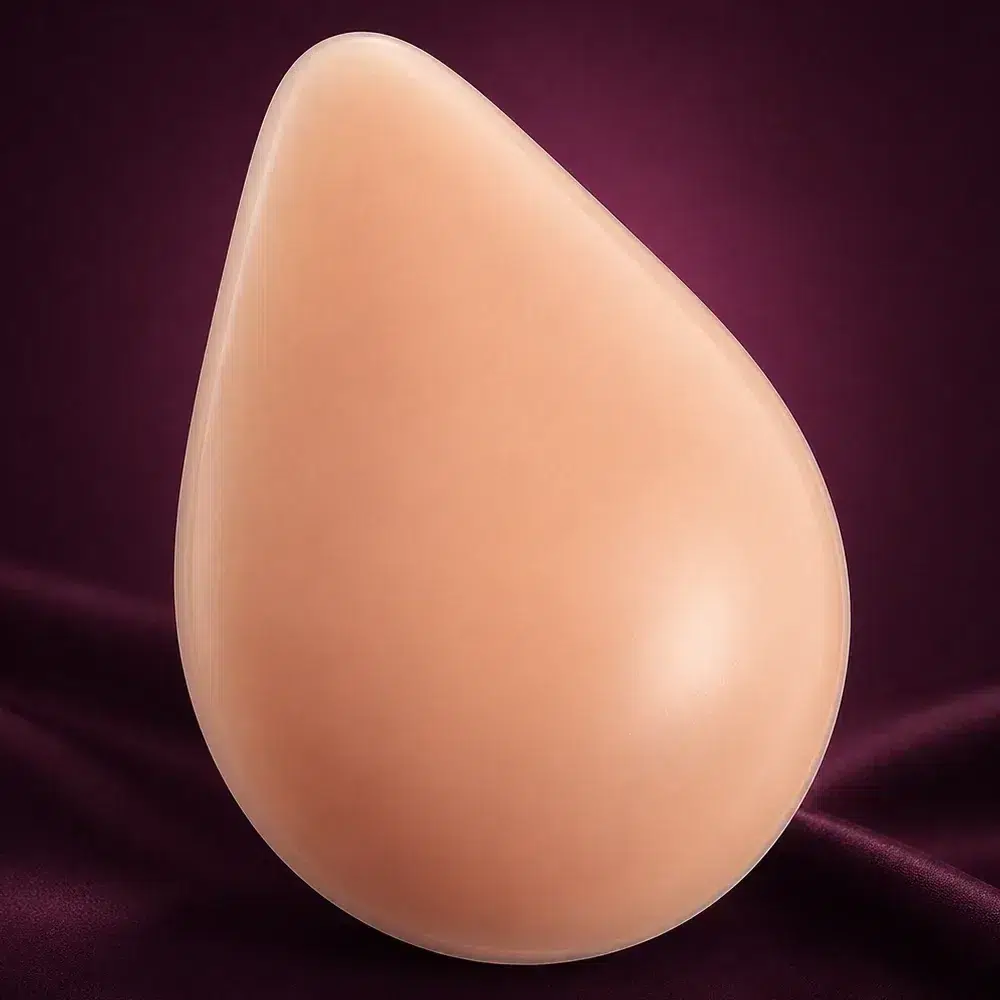 01
01
Versatile Shape
Oval Breast Forms
Oval breast forms have an elongated profile that spreads fullness over a relatively generous area of the chest. Compared size-for-size with many triangular designs, an oval form can provide a softer profile with less pronounced forward projection.
One of the useful characteristics of a symmetrical oval form is its flexibility. Depending on the particular model, it may be worn more vertically or turned to place additional fullness towards the upper or outer chest.
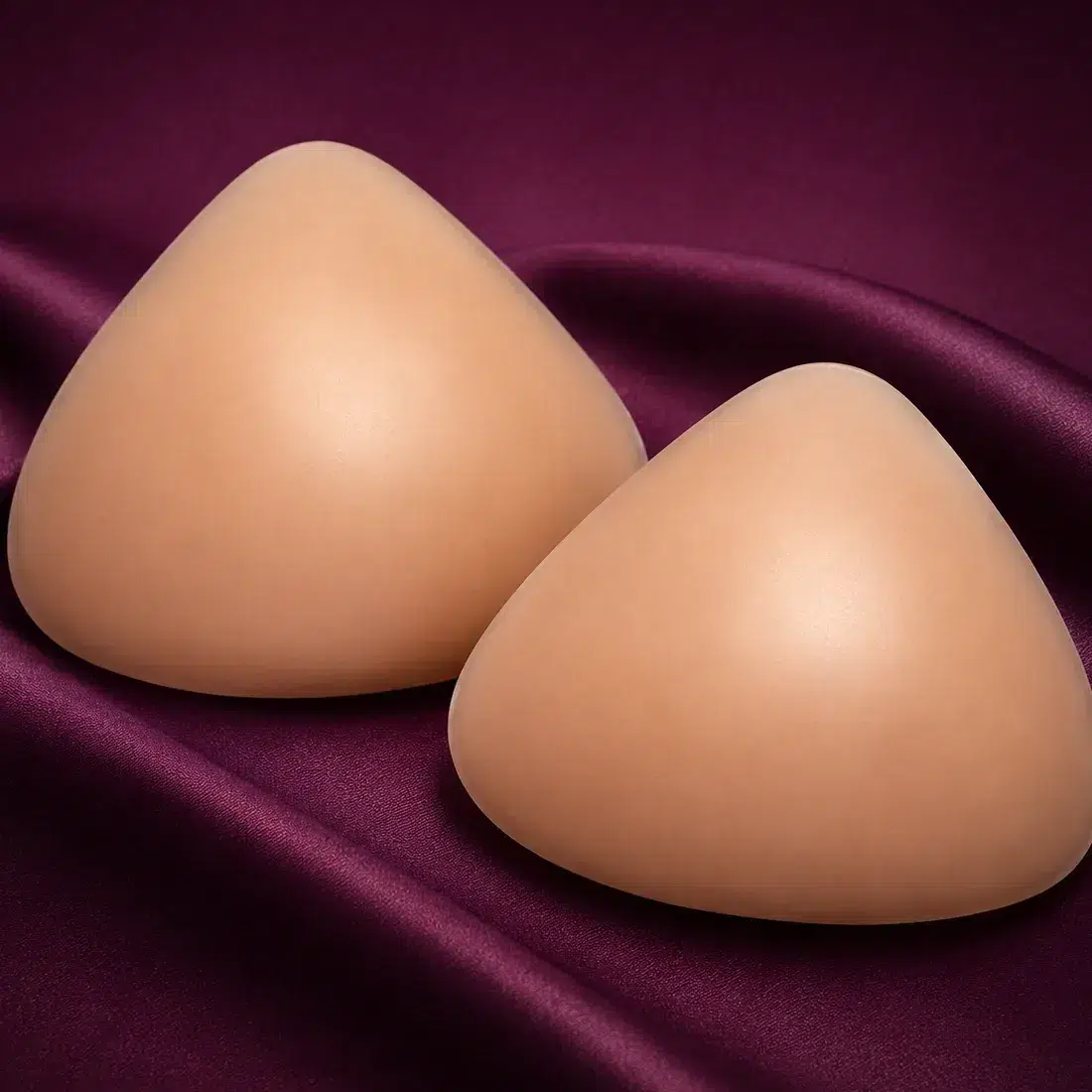 02
02
Stronger Projection
Triangular Breast Forms
Triangular breast forms use a broader three-sided footprint across the chest. Within the Translife range, triangular forms generally provide more forward projection than a comparable oval form, creating a fuller and more pronounced bust profile.
Many triangular forms also have a contoured or concave rear surface. This can help the form sit around existing pectoral or chest development rather than simply resting on top of it.
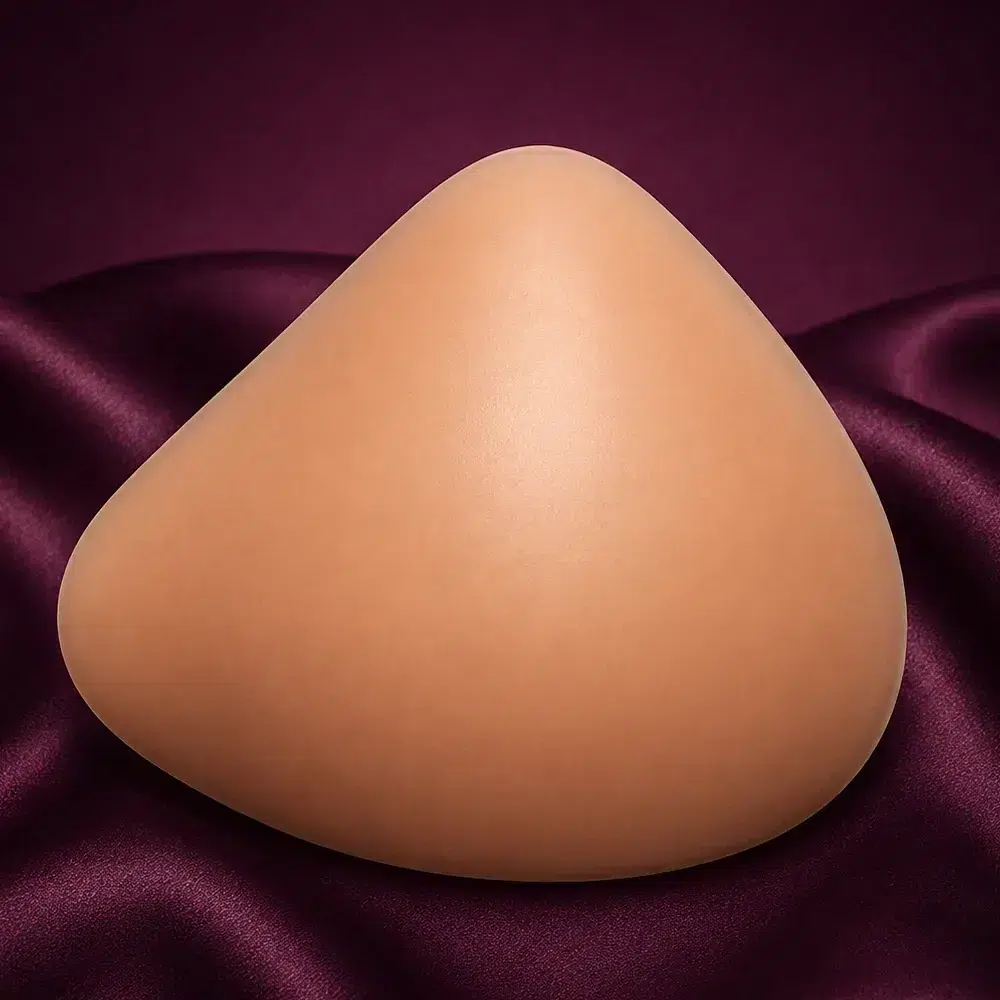 03
03
Left & Right Specific
Classic Asymmetrical Breast Forms
Classic breast forms take a different approach. Rather than using the same shape on both sides of the body, they are asymmetrical, with a dedicated left and right form.
Their shape combines an extended outer wing with substantial frontal fullness. Correctly positioned, that wing can follow the chest towards the underarm while the main body of the form creates the breast projection.
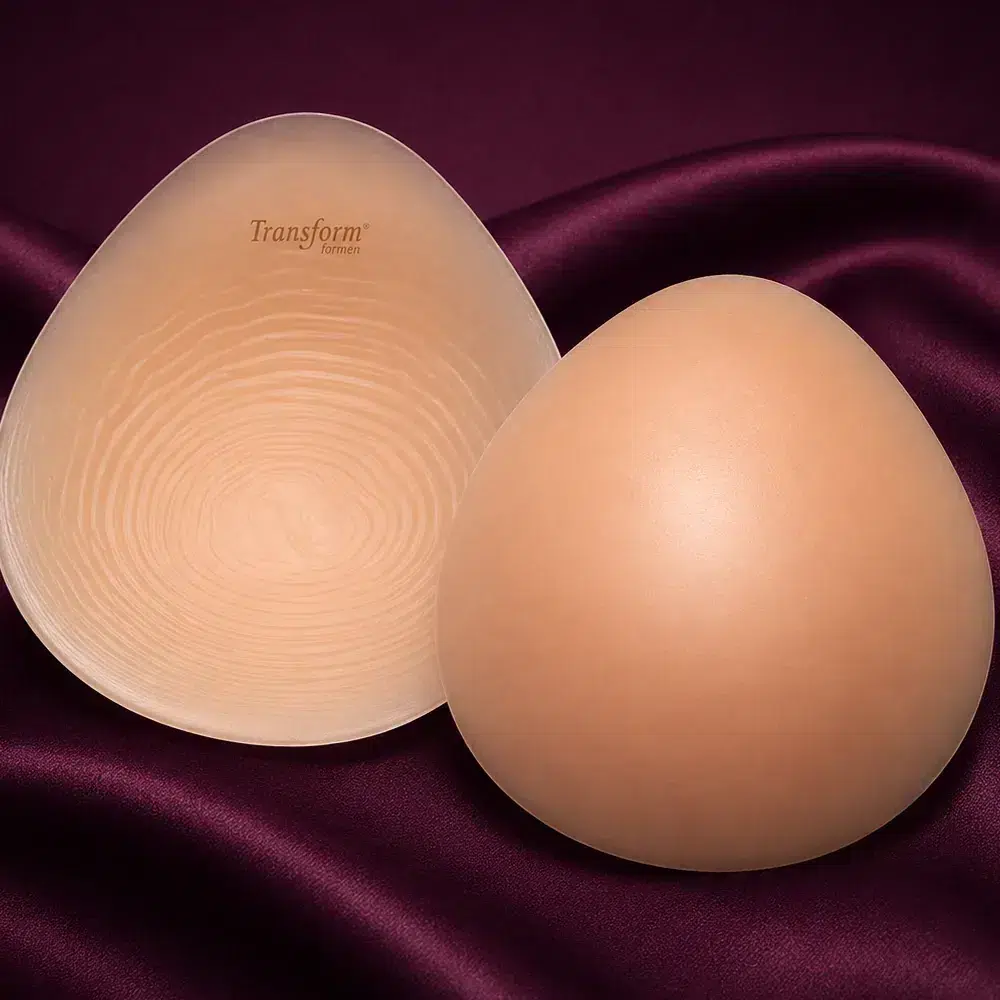 04
04
Rounded Fullness
Semi-Round Breast Forms
Semi-round breast forms concentrate their shape into a fuller, more rounded profile. Their curved design produces an even, prominent bust shape and can create an appearance similar to an enhanced or implant-style breast.
Translife semi-round forms are symmetrical, so the same form can be used on either side of the body. Their curved rear surface is designed to sit snugly against the chest wall.
Quick Comparison
Start With the Shape You Want to Create
These descriptions are a starting point rather than rigid rules. Your chest dimensions, breast-form size, bra and positioning will all influence the finished result.
Versatile, elongated and useful for distributing fullness over the chest.
Broad footprint with a stronger, more pronounced forward profile.
Left/right anatomical shaping combining projection with an extended outer wing.
Rounded, full and suited to a more enhanced breast profile.
Shape Names Are Only the Starting Point
Not every manufacturer's oval, triangle or semi-round form will have identical proportions. Always consider the actual width, height, projection and rear contour of the form as well as the name given to its shape.
Symmetrical or Asymmetrical?
Why Left and Right Matter When Choosing Breast Forms
One of the most important differences between breast forms is whether the pair is symmetrical or asymmetrical. The distinction affects how the forms are positioned, how much freedom you have to adjust them and how their shape follows your chest.
Interchangeable Pair
Symmetrical Breast Forms
A symmetrical breast form has essentially the same overall shape regardless of whether it is placed on the left or right side of your chest. You therefore do not normally have a dedicated left and right form.
This makes symmetrical forms particularly flexible. Depending on the design, some can also be rotated slightly to alter where their height, width or fullness sits.
- Either form can normally be worn on either side.
- Simple to position and swap between left and right.
- Some shapes offer useful rotational flexibility.
- Available in several profiles, including oval, triangular and semi-round designs.
Anatomical Pair
Asymmetrical Breast Forms
Asymmetrical breast forms are designed as a specific left and right pair. Their outer shape is deliberately different on each side so that the form follows a particular orientation across the chest.
A common design uses an extended outer section or “wing” that continues towards the underarm. When the form is positioned correctly, this can help distribute its shape across the chest rather than concentrating everything directly at the front.
- Separate left and right breast forms.
- Designed to be worn in a particular orientation.
- Can extend naturally towards the outer chest.
- Correct positioning is important to achieve the intended shape.
A Real Asymmetrical Example
Look at the Shape Before You Look at the Size
These Classic breast forms from the Translife range make the difference particularly easy to see. The two forms are mirror images rather than identical pieces.
Notice how the main breast volume is accompanied by an extended section towards the outside of each form. When worn on the correct side, this allows the shape to continue towards the outer chest and underarm.
An Important Distinction
Asymmetrical Does Not Automatically Mean More Natural
It can be tempting to assume that a dedicated left/right anatomical form must always produce a more realistic result. In practice, breast-form choice is more individual than that.
A well-proportioned symmetrical form can look excellent on one person, while an asymmetrical design may integrate particularly well with another person's chest. Your torso, bra, breast-form dimensions and preferred silhouette all contribute to the result.
Which Should You Choose?
Think About Flexibility Versus Anatomical Positioning
Consider Symmetrical Forms If...
You value flexibility, want straightforward left/right positioning or would like the option to experiment with the orientation of a compatible breast-form shape.
Consider Asymmetrical Forms If...
You prefer a dedicated anatomical left/right shape and want the form to follow a more specific path across the chest towards the outer body.
Check Orientation Before You Judge the Fit
If you are wearing asymmetrical breast forms, first make sure the correct form is on each side and that its outer extension is pointing in the intended direction. A form worn incorrectly can look poorly positioned even when its size is otherwise suitable.
Projection, Fullness & Profile
Where Breast Form Volume Sits Can Matter as Much as How Much There Is
Breast-form size tells only part of the story. The same general amount of volume can be spread broadly across your chest or concentrated further forwards, producing noticeably different feminine proportions.
Understanding projection, fullness and profile helps explain why two breast forms that appear similar in size can look very different once they are worn with a bra and clothing.
Projection
Projection is the distance the breast form extends forwards from your chest. Greater projection produces a more prominent side profile, while shallower projection keeps more of the form's volume closer to the torso.
Fullness
Fullness describes where the breast volume is visually concentrated. A form may appear fuller through the upper breast, lower breast, centre or across a broader area of the chest.
Profile
Profile is the overall contour created when the form is viewed from the side. It is influenced by projection, fullness, the rear contour of the form, your chest and the support provided by your bra.
Understanding Projection
Bigger Does Not Always Mean Further Forward
A larger breast form can distribute its volume over a wider and taller area of the chest, while another design may use less overall volume but concentrate more of it forwards. That means apparent bust prominence cannot be predicted reliably from a size label alone.
This becomes particularly important when creating feminine proportions on a broader torso. Increasing projection can make the bust more visually prominent, but increasing width may sometimes create better balance without requiring an excessively projected profile.
The aim is not automatically to create the largest possible bust. It is to find a relationship between chest width, breast width and forward projection that produces the silhouette you want.
Understanding Fullness
Breast Volume Can Be Distributed in Different Places
Projection tells you how far forwards the form comes. Fullness helps describe where its visible volume sits. This distribution can significantly change the character of the finished bust.
Upper Fullness
More visible volume through the upper part of the breast can create a rounder, more enhanced appearance, particularly through lower or open necklines.
Central Fullness
Concentrating volume through the main body of the breast can produce a defined forward bust while retaining a relatively balanced upper and lower contour.
Lower Fullness
Greater volume towards the lower part of the form can create a softer downward curve and a less uniformly rounded upper breast profile.
Distributed Fullness
Spreading volume across a wider footprint can create useful balance across a broader chest without relying entirely on greater forward projection.
The Bra Changes the Result
A Breast Form Does Not Create Its Final Profile in Isolation
Once a breast form is placed inside a bra, the cup begins to influence where the form sits and how its volume is supported. A fuller-coverage cup, plunge, balconette or other bra construction can therefore present the same breast form differently.
If the form and cup are poorly matched, the bra may compress the form, leave empty space, push it into an unintended position or allow it to sit too far apart.
This is why breast-form projection should not be assessed purely by holding the form against your bare chest. The finished profile is the result of the body + breast form + bra working together.
We explore that relationship in more detail later in this guide when looking specifically at how breast-form shape works with your bra.
Look Beyond the Bra
Check the Silhouette With Clothing On
Breast forms are ultimately part of a complete outfit. Clothing changes how their projection and fullness are perceived, sometimes quite dramatically.
A form that initially appears prominent in lingerie may look beautifully proportioned beneath a dress, blouse or knit, while a shape that seems modest before dressing may become more noticeable once clothing follows the bust contour.
Check From More Than One Angle
Does the bust width balance your torso and shoulders?
Does the amount of forward projection feel appropriate?
Does the transition from chest to breast look balanced?
Aim for Proportion, Not a Particular Cup Letter
Projection, fullness and profile help you judge what a breast form is actually doing to your silhouette. Use the labelled size as useful guidance, but make your final judgement from the relationship between the forms, your chest, your bra and how you look once dressed.
Your Chest & Body Proportions
Choose Breast Forms to Work With Your Body, Not Against It
The most convincing breast-form shape is not determined by a single body type or a particular cup size. What matters is how the width, projection and position of the forms relate to your chest, shoulders, torso and overall feminine silhouette.
For many crossdressers, the natural chest is broader than the frame for which mainstream lingerie sizing was originally designed. That does not mean you need excessively large breast forms. It means proportion should be considered carefully.
The Proportion Principle
Think Across the Whole Upper Body
A breast form becomes part of the visual structure of your upper body. Its width affects how much of the chest is occupied, while its projection affects how strongly the bust comes forwards.
Those two dimensions need to work together. A form can have impressive projection but still look too narrow for the chest, while a very broad form can provide excellent coverage yet create less forward emphasis than expected.
Four Things to Consider
Build the Bust Around Your Existing Proportions
Rather than starting with a cup letter, look first at the physical proportions the breast forms need to work with.
Chest Width
A broader chest often benefits from a breast form with enough width to occupy the chest naturally rather than leaving all of the volume concentrated towards the centre.
Shoulder Width
The bust sits visually beneath the shoulders. If your shoulders are relatively broad, enough breast width and volume can help create a more balanced transition through the upper body.
Torso Length
The vertical dimensions of a breast form can influence where the bust appears to begin and end on your torso. Taller forms can spread their shape over more of the chest, while compact forms concentrate volume into a smaller area.
Overall Silhouette
Your bust is only one part of the finished shape. Waist, hips, clothing, shapewear and footwear all influence how large or small the breasts appear in the complete look.
Width Versus Projection
A Fuller-Looking Bust Does Not Always Require a Larger Form
Changing the relationship between width and projection can alter the finished appearance without simply increasing the overall breast-form size.
Stronger Forward Emphasis
A narrower form can concentrate more visual volume forwards. This may create a pronounced side profile, but on some broader chests it can also make the forms appear more separate from the torso.
More Chest Coverage
A broader form spreads breast volume across a wider area. This can sometimes create excellent balance on a broader torso without producing an excessively prominent forward profile.
Your Natural Chest Matters
The Breast Form Has to Sit on the Body You Already Have
Breast forms do not sit against an identical flat surface on every wearer. Natural chest tissue, pectoral development, ribcage shape and the contour of the chest wall can all influence how a form makes contact with your body.
Some forms have a flatter rear surface, while others are contoured or concave. A compatible rear shape can help the form sit more comfortably and may allow the front profile to appear more integrated with the chest.
Consider whether the rear of the form can sit naturally against your chest wall.
Natural chest volume may alter how far the breast form eventually projects.
A form with suitable width or an outer extension can help distribute the bust across the torso.
A Common Mistake
Do Not Choose Breast Forms Only Because They Look Large Enough Off the Body
Breast forms can appear surprisingly substantial when held in your hands, yet look far more moderate once distributed across a wider chest and supported by clothing. The opposite can also happen: highly projected forms may appear much more prominent once worn than their physical dimensions initially suggest.
A Practical Mirror Check
Judge Proportion From Several Views
Front View
Look at how the bust width relates to your shoulders, ribcage and waist. Does it feel integrated into the torso rather than sitting as two separate shapes?
Side View
Check whether the forward projection creates the profile you want and whether it feels balanced with the rest of your body.
Three-Quarter View
This is often where the relationship between chest width, breast projection and outer fullness becomes easiest to see.
Fully Dressed
Finally, check the forms under the clothing you actually intend to wear. This is the silhouette that matters most.
There Is No Single “Correct” Breast Size for Your Body
The goal is proportion, comfort and the feminine silhouette you want to create. Use your chest and body dimensions as useful information, but allow personal preference to remain part of the decision. A subtle result and a more glamorous result can both be completely valid.
Breast Forms & Bras
A Breast Form and Bra Need to Work as One
Even a well-chosen breast form can give a disappointing result if the bra does not support its width, height and projection correctly. The breast form creates the volume, but the bra helps determine where that volume sits and how the finished bust is shaped.
This is why choosing a breast form by cup size alone can be misleading. The same labelled breast form may sit beautifully in one bra and poorly in another because cup construction, coverage and positioning are different.
The Three-Part Fit
Body + Breast Form + Bra
The finished silhouette is created by all three working together. Changing any one of them can change the result.
Your Chest
Chest width, ribcage shape, natural tissue and the distance between the breasts all influence where the forms can sit comfortably.
The Breast Form
Its width, height, projection and rear contour determine how much space it occupies and the profile it is capable of creating.
The Bra
The band anchors the bra while the cups contain, position and support the forms. Cup shape can change where the breast volume appears to sit.
Cup Shape Matters
The Form Has to Fit the Shape of the Cup, Not Just Its Label
A bra cup is three-dimensional. It has its own width, depth, height and curvature, so two bras carrying the same band and cup label can hold a breast form quite differently.
A breast form that is too wide for the cup may be compressed or pushed outwards. A form that is too narrow may leave unused space towards the sides of the cup. If projection and cup depth do not agree, the form may either push the cup forwards excessively or fail to fill it properly.
The cup should contain and support the form without excessive compression, obvious empty space or uncontrolled movement.
Four Important Relationships
Check More Than the Cup Letter
Form Width & Cup Width
The breast form needs enough horizontal space inside the bra. If the cup is too narrow, the form may be squeezed towards the centre or forced towards the underarm.
Projection & Cup Depth
A highly projected breast form requires enough cup depth to contain it. A shallower cup may compress the form and alter its intended profile.
Form Height & Cup Coverage
Taller forms may benefit from a cup that provides enough vertical coverage to support their upper section, while compact forms may work well with lower-cut styles.
Position & Cup Separation
The distance between the bra cups influences how close together the forms can sit. This affects central fullness, cleavage appearance and the overall width of the bust.
What Poor Compatibility Looks Like
The Bra Can Tell You When Something Is Wrong
Several common fitting problems are actually signs that the form and bra are not working together correctly.
Empty Cup Space
Gapping or hollow areas can indicate that the form does not fill the particular cup shape, even if the labelled size appears correct.
Form Spilling From the Cup
Visible overflow at the top or side may mean the cup lacks sufficient volume, width or coverage for the form.
Excessive Compression
A cup that is too shallow can flatten a projected form and change the silhouette you originally chose it for.
Movement or Instability
If the form moves excessively, the bra may not be holding it securely enough or the cup may be a poor match for its shape.
Do Not Forget the Band
Cup Fit Cannot Compensate for the Wrong Bra Band
The band provides much of the bra's stability. If it is too loose, the bra can move around the torso and allow the breast forms to shift with it. If it is unnecessarily tight, comfort suffers and the cups may be pulled into an unintended position.
Before judging whether your breast forms fit the cups, make sure the bra itself is sitting securely and level around your body.
Bra Style Changes the Presentation
The Same Breast Forms Can Create More Than One Look
Bra construction changes how the bust is supported and presented. These are general effects rather than rigid rules because individual bras vary considerably.
Full-Cup Styles
Greater coverage can help contain taller or fuller forms and may provide a reassuringly secure fit.
Balconette Styles
Lower upper coverage can present more of the upper bust, but the form still needs to sit securely inside the cup.
Plunge Styles
A lower centre may allow greater central presentation, provided the shape and position of the forms remain secure.
Pocket Bras
Built-in pockets hold breast forms within the bra itself, offering additional security and more controlled positioning.
Practical Fit Check
Before Deciding the Combination Works, Check These Five Things
-
01
Set the bra correctly first.
Make sure the band is level and the straps are adjusted before positioning the breast forms.
-
02
Place both forms consistently.
Check that they sit at a similar height and distance from the centre of your chest.
-
03
Check the entire cup.
Look for empty space, compression, folding or breast-form edges escaping from the cup.
-
04
Move around.
Raise your arms, sit down and walk. A good fit should remain stable during normal movement.
-
05
Put your clothing on.
The final test is the silhouette the breast form and bra create beneath the outfit you intend to wear.
Do Not Expect the Bra to Fix the Wrong Breast Form
A supportive bra can position and present a breast form beautifully, but it cannot completely correct a form whose width, height or projection is fundamentally unsuitable for your chest. Choose the breast form and bra as a combination, then judge the result as a complete silhouette.
Positioning Your Breast Forms
Small Changes in Position Can Completely Change the Finished Silhouette
Choosing the right breast form is only part of the process. Where you place the forms on your chest affects bust height, separation, outer fullness, projection and how naturally the whole shape works with your body.
There is no single exact position that suits everybody. Your chest width, breast-form shape, bra construction and personal preference all influence the final placement.
Key Principle
Position the Breast Forms for the Finished Bust, Not for a Fixed Rule
Breast forms should look as though they belong to your torso. Instead of trying to place them at an arbitrary measurement, use the bra, your chest proportions and the final dressed silhouette to guide you.
Four Positioning Variables
Height, Separation, Angle and Orientation All Matter
These four adjustments can alter how the same pair of breast forms looks without changing the forms themselves.
Bust Height
Raising or lowering the forms changes where the bust sits visually on your torso. Too high can make the breasts look perched on the chest, while too low may make the whole upper body appear heavier or longer.
Breast Separation
Moving the forms closer together increases central fullness, while moving them further apart spreads the bust across more of the chest. The bra itself may limit how much adjustment is realistically possible.
Angle
Some symmetrical breast forms can be rotated slightly. This may move fullness upwards, downwards or towards the outer chest depending on the shape of the form.
Left / Right Orientation
Asymmetrical breast forms are designed for a specific side of the body. Their outer extension or anatomical shaping only works as intended when the correct form is placed on the correct side.
Finding the Right Height
Avoid Judging Position From the Breast Forms Alone
A breast form can look correctly positioned when viewed in isolation but noticeably different once you step back and look at the complete upper body.
The breasts can appear detached from the natural line of the torso or sit unusually close to the shoulders.
The bust feels integrated into the upper body and works naturally with the proportions of the chest and torso.
The bust may visually lengthen or weigh down the torso, particularly with larger or more projected forms.
Central Versus Outer Position
Do Not Force Breast Forms Together Simply to Create Cleavage
Moving breast forms towards the centre can create more visible fullness between them, but there is a practical limit. On a broader chest, forcing the forms too close together can leave the outer chest empty and make the overall bust look narrow compared with the torso.
Moving them slightly further out can sometimes create a more balanced silhouette because the breast width relates better to the width of the ribcage and shoulders.
The best position is therefore not necessarily the position that produces the deepest cleavage. It is the position that gives the most convincing overall proportion.
More central fullness, but potentially less balance across a broader torso.
Greater chest coverage and potentially more natural balance across the upper body.
Your Bra Sets the Boundaries
Good Positioning Still Has to Work Inside the Cup
Once the breast forms are inside a bra, the cups and centre gore influence how much freedom you have to move them. A position that looks attractive against the bare chest may not work if the form then sits outside the intended area of the cup.
Set the bra correctly first, place the forms inside it and then fine-tune their position. This gives you a more realistic indication of how the combination will behave when worn.
Positioning Asymmetrical Forms
Let the Shape Follow the Outer Chest
With asymmetrical breast forms, positioning is more specific because the pair has a dedicated left and right side. The extended section of the form is generally intended to follow the chest towards the outside of the body.
If the form is positioned incorrectly or placed on the wrong side, the extension can point in the wrong direction and the main breast volume may no longer sit where the designer intended.
The Classic form provides a clear real-world example of left and right orientation.
A Practical Positioning Routine
Use This Five-Step Check Each Time You Fit Your Breast Forms
-
01
Put the bra on correctly.
Check that the band is level and secure before inserting or positioning the breast forms.
-
02
Set the initial height.
Place both forms at approximately the same level, then look at the bust in relation to your shoulders and torso.
-
03
Adjust the separation.
Move the forms slightly inwards or outwards until the bust width feels balanced across your chest.
-
04
Check orientation and angle.
Confirm left and right if the forms are asymmetrical, or fine-tune rotation where a symmetrical design allows it.
-
05
Dress and check again.
Put on your intended clothing and review the front, side and three-quarter silhouette before making your final adjustment.
Do Not Stop at the Mirror
A Good Position Should Remain Stable When You Move
Once you are satisfied with the appearance, walk around, sit down and raise your arms. Normal movement can reveal whether the breast forms are shifting, rotating or escaping from the cup.
Positioning Is Part of Breast Form Fit
If a pair of breast forms initially looks disappointing, do not assume the shape or size is automatically wrong. Check their height, separation, orientation and relationship with the bra first. A small adjustment can sometimes make a surprisingly large difference to the finished feminine silhouette.
Choosing Your Breast Form Shape
Bring Everything Together and Choose the Shape That Suits You
By this stage, you have seen that breast-form choice is not really about finding one universally “best” shape. The useful question is which shape gives you the width, projection, fullness and positioning flexibility that best matches your body and the feminine silhouette you want to create.
Use this practical framework to move from measurements and preferences to a sensible starting choice without becoming distracted by cup labels alone.
The Translife Approach
Choose the Effect First — Then Choose the Form
Start with the finished silhouette you want to create. Then compare breast-form shape, width, height and projection against your own chest and the bra you intend to wear.
A Simple Decision Path
Work Through These Six Questions in Order
You do not need to solve everything at once. Each step narrows the possibilities and makes the next decision easier.
Start With Your Body
How Broad Is Your Chest?
Your chest width gives you the physical area the breast forms need to occupy. A broader torso may benefit from a form with enough width to integrate naturally rather than concentrating all the volume into a narrow central area.
Decide the Look
Do You Want Subtle, Balanced or Fuller?
Decide what you are actually trying to create before comparing products. Some people prefer a modest everyday bust, while others deliberately want a fuller or more glamorous feminine shape.
Choose the Distribution
Where Do You Want the Fullness to Sit?
Decide whether you prefer volume distributed broadly across the chest, stronger forward projection, a rounded enhanced profile or a dedicated left/right anatomical-style shape.
Check the Bra
Will the Shape Work Inside the Cup?
The breast form needs enough width, depth and coverage inside the bra. A suitable form can still produce a poor result if the cup shape compresses it or leaves too much unused space.
Check the Wardrobe
What Happens Once You Get Dressed?
Breast forms change your finished bust measurement. Consider how the additional width and projection will work with dresses, tops, blouses and jackets you actually intend to wear.
Make the Final Choice
Do You Genuinely Like the Complete Silhouette?
Measurements help you predict the result, but your preference makes the final decision. Look at the complete figure rather than judging the breast forms in isolation.
Shape Decision Guide
Which Direction Best Matches the Look You Want?
These are practical starting points rather than rigid rules. The exact dimensions of the form still matter.
Choose Oval If You Want Versatility and Distributed Fullness
Oval forms can be a useful starting point when you prefer a longer, more softly distributed shape across the chest and value positioning flexibility.
Choose Triangle If You Want Stronger Forward Presence
Triangular forms can provide a broad footprint while producing a more pronounced forward profile than a comparable oval design.
Choose Classic If You Want a Dedicated Left and Right Shape
The Classic design combines substantial frontal fullness with an extended outer section that follows the chest towards the underarm.
Choose Semi-Round If You Prefer Rounded, Fuller Contours
Semi-round forms create a compact, rounded profile and can suit someone looking for a visibly fuller, more enhanced feminine bust.
Start With the Effect
Three Different Goals Can Lead to Three Different Choices
Subtle & Everyday
Look for moderate projection, sensible chest coverage and a shape that integrates easily beneath your usual clothing.
Balanced & Feminine
Prioritise proportion between chest width, breast width, forward projection, shoulders, waist and hips.
Fuller & Glamorous
Greater projection and volume may be exactly what you want. Just consider the extra demands placed on the bra, clothing and overall body balance.
Compare the Actual Form
Product Dimensions Tell You More Than a Suggested Cup Size
Once you have narrowed down the shape you want, compare the manufacturer's physical specifications wherever reliable information is available.
Suggested cup size can be helpful as a broad reference, but it does not tell you exactly how wide, tall or projected the form will be on your body.
How much horizontal space will it occupy?
How much vertical area of the chest will it cover?
How far forward will the bust extend?
How much overall breast fullness is being added?
Proportion Is Guidance — Not a Rule
You Are Still Allowed to Choose the Bust You Want
Understanding proportion is not about telling you what size or shape you are permitted to wear. It is about helping you predict what a particular breast form is likely to do to your body, bra and wardrobe before you buy it.
A subtle shape can be right for one person. A generously projected, glamorous bust can be right for another. Both choices can be informed choices.
The 30-Second Check
Before You Make Your Choice, Ask Yourself These Five Things
Does the form suit the width of my chest?
Is this the amount of forward projection I actually want?
How will the bust relate to my shoulders, waist and hips?
Will the finished bust still work with my wardrobe?
Do I have a bra that can support and contain this form?
Stop Choosing a Breast Form in Isolation — Start Choosing a Silhouette
The most useful breast form shapes guide cannot tell you that one shape is automatically right for everybody. Instead, combine your chest proportions, desired projection, fullness, bra fit, clothing and personal preference. Once you understand the effect each option is likely to create, the right starting choice becomes much clearer.
Common Breast Form Mistakes
Most Disappointing Results Come From Fit and Proportion — Not the Breast Forms Themselves
It is easy to assume that an unsatisfactory result means you bought the wrong breast forms. Sometimes that is true, but many common problems actually come from choosing by cup size alone, using the wrong bra, placing the forms poorly or judging them before seeing the complete dressed silhouette.
Before replacing a pair of breast forms, work through these common mistakes. A simple change in size, shape, positioning or bra fit can make a significant difference.
Before You Decide the Forms Are Wrong
Check the Whole Fitting System
The finished result comes from your chest, the breast forms, the bra, their position and your clothing working together. If one part is wrong, the whole bust can look wrong.
Eight Common Mistakes
What Goes Wrong — and What to Try Instead
Choosing Only by Cup Size
A suggested cup size does not tell you the exact width, height or projection of a breast form. Two forms aimed at a similar cup size can create very different silhouettes.
Compare actual dimensions and shape as well as the suggested cup size.
Assuming Bigger Always Looks More Feminine
Increasing volume can certainly create a fuller, glamorous bust, but larger forms do not automatically create better feminine proportions.
Consider chest width, shoulders, waist, hips and the overall silhouette you want.
Ignoring Width and Projection
Breast volume can be distributed broadly across the chest or concentrated further forwards. Ignoring that difference can leave the bust too narrow, too shallow or more prominent than expected.
Look at width, height and projection together rather than treating size as a single number.
Expecting Any Bra in the Right Cup Size to Work
Bra cups vary in width, depth, coverage and construction. A breast form can fit one bra beautifully and sit poorly in another carrying the same size label.
Judge the breast form and bra as a combination, not as two separate purchases.
Placing the Forms Too High or Too Close Together
Forms positioned very high can look detached from the torso, while forcing them towards the centre can leave the outer chest visually empty.
Adjust height and separation while viewing the complete upper body rather than focusing only on cleavage.
Wearing Asymmetrical Forms on the Wrong Side
Left and right asymmetrical forms are shaped for a particular side of the chest. Swapping them can put the outer extension in the wrong direction and move the main fullness away from its intended position.
Confirm left and right orientation before making any other fitting adjustment.
Judging the Forms While Holding Them in Your Hands
Breast forms can look surprisingly large before they are worn. Once their volume is spread across the chest, supported by a bra and covered by clothing, the apparent size can change dramatically.
Fit the forms properly and judge them while dressed from several angles.
Following a Proportion Rule You Do Not Actually Like
Proportion guides are useful for predicting an effect, but they are not rules about what you are allowed to wear. Your preferred feminine presentation still matters.
Understand the likely result, then choose the silhouette that genuinely feels right for you.
Quick Diagnosis
If the Result Looks Wrong, Start With What You Can See
The appearance of the problem can often tell you which part of the fitting system to check first.
Cleavage Is Not the Only Measure of Success
A Convincing Bust Can Look Beautiful Without Deep Central Cleavage
Cleavage depends on much more than breast-form size. Chest width, natural tissue, form position and bra construction all influence how much central fullness can realistically be created.
Trying to force breast forms together purely to maximise cleavage can compromise width, position and overall balance. A softer gap between the breasts may actually produce the stronger finished silhouette.
Troubleshooting Tip
Change One Thing at a Time
If the result is not right, avoid changing the bra, form position, straps and clothing all at once. Make one adjustment, look again from the front, side and three-quarter view, then decide whether it improved the silhouette.
Before You Buy Another Pair
Run This Five-Point Rescue Check
-
01
Check left and right orientation.
If the breast forms are asymmetrical, make sure they are on the correct side before adjusting anything else.
-
02
Reset the bra.
Make sure the band is level, straps are comfortable and the cups are sitting correctly.
-
03
Adjust height and separation.
Small changes in breast-form position can alter the entire upper-body silhouette.
-
04
Check the cup around the whole form.
Look for compression, empty space, exposed edges or poor containment.
-
05
Get fully dressed.
Judge the result under clothing and from several angles before deciding that the form itself is wrong.
Sometimes the Form Really Is the Wrong Choice
Know When Adjustment Is No Longer Enough
Positioning cannot turn a breast form with insufficient width into one that naturally covers a much broader chest.
A bra can support projection, but it cannot make an extremely prominent form behave like a shallow one.
If the fullness distribution is fundamentally different from the look you want, another shape may be a better choice.
Personal preference is a valid reason to choose something different, even when the technical fit is acceptable.
Diagnose the Problem Before You Replace the Breast Forms
Good breast-form fitting is a process of small adjustments. Check shape, width, projection, bra fit, position and the final dressed silhouette before deciding what needs to change. When you identify the real cause of the problem, choosing the right solution becomes much easier.
Breast Form Shapes FAQ
Frequently Asked Questions About Breast Form Shape and Fit
Choosing breast forms can feel complicated because shape, size, projection, chest proportions, bra fit and positioning all affect the final result. These quick answers bring together the most important points from this breast form shapes guide.
01 Which breast form shape is best?
There is no single breast form shape that is best for everybody. The right choice depends on your chest width, desired projection, preferred fullness, bra, clothing and the feminine silhouette you want to create.
Oval, triangular, Classic asymmetrical and semi-round forms each distribute their volume differently, so the most useful comparison is how each shape works on your own body rather than which one has the “best” label.
02 Is breast form shape more important than cup size?
Both matter, but cup size alone gives an incomplete picture. Two breast forms associated with a similar cup size can have different widths, heights and projection, producing noticeably different results.
Use the suggested cup size as guidance, then consider the actual dimensions and shape of the form.
03 What is the difference between oval and triangular breast forms?
Oval forms generally distribute their shape over a longer area and can provide useful positioning flexibility. Triangular forms tend to offer a broad footprint combined with stronger frontal projection.
Size for size, the finished appearance can therefore be quite different even when the overall breast volume is broadly comparable.
04 What are asymmetrical breast forms?
Asymmetrical breast forms are supplied as a dedicated left and right pair rather than two interchangeable shapes. Their outer contour is designed differently on each side so the form can follow the chest towards the outside of the body.
Correct left and right positioning is important because reversing them changes where the outer extension and main breast volume sit.
05 Are symmetrical breast forms easier to wear?
They can be simpler because either form can normally be worn on either side. Some symmetrical designs can also be rotated slightly to change how their height, width or fullness is presented.
That does not automatically make them better than an asymmetrical pair. It simply gives you a different type of positioning flexibility.
06 How much breast form projection should I choose?
Choose projection according to the side profile you want rather than assuming more projection is always better. Shallower forms keep volume closer to the chest, while greater projection creates a more prominent bust.
On a broader torso, additional width can sometimes create better balance than simply increasing how far the breasts project forwards.
07 Should a broader chest always have larger breast forms?
No. A broader chest does not automatically require a dramatically larger bust. What often matters more is choosing enough breast-form width or footprint to create a convincing transition across the torso.
A moderately sized but broader form can sometimes look more proportionate than a narrower form with much greater projection.
08 Can the same breast forms look different in different bras?
Yes. Bra cups vary in width, depth, height, coverage and construction. One bra may lift and contain a breast form particularly well, while another bra in the same labelled size may compress it or leave unwanted space.
The breast form and bra should therefore be considered as a combination.
09 Where should breast forms sit on the chest?
There is no single fixed measurement that suits every wearer. Position them so the bust height and separation look balanced with your chest, shoulders, torso and bra.
Avoid concentrating only on cleavage. Breast forms forced too close together can make the bust appear unusually narrow compared with the rest of the chest.
10 Can I rotate breast forms to change their shape?
Some symmetrical breast forms allow a degree of rotation, which can alter where their height or fullness appears on the chest.
Asymmetrical forms should normally be positioned according to their dedicated left and right orientation rather than freely rotated.
11 Why do my breast forms look much smaller once I put them on?
A breast form can appear very substantial when viewed in your hand. Once its volume is distributed across the chest, contained by a bra and seen in relation to your whole body, it may appear considerably more moderate.
This is one reason it is important to judge breast forms while properly fitted and fully dressed.
12 Do I need a special bra for breast forms?
Not always. Breast forms can be worn with suitable conventional bras when the cups provide the necessary shape, support and containment.
Pocket bras provide an additional option because the breast forms are held inside dedicated pockets, which can improve security and help control positioning.
13 Which breast form shape gives the most natural result?
Natural-looking results come from proportion and integration rather than one particular shape name. A breast form that suits your chest width, projection, bra and positioning can look convincing regardless of whether it is oval, triangular, semi-round or asymmetrical.
The best test is the complete silhouette from the front, side and three-quarter view.
14 What should I check before buying breast forms?
Start with your chest and the silhouette you want, then compare the form's shape, physical width, height, projection and suggested size. Consider whether your bra can accommodate the form and whether the resulting bust will work with the clothing you intend to wear.
Most importantly, do not choose from the cup-size label alone.
The Breast Form Shapes Guide in One Minute
Five Principles Worth Remembering
Breast volume can be distributed in very different ways.
Width, height and projection tell you much more.
Choose forms in relation to your chest and overall frame.
Cup construction influences support, position and profile.
The aim is the feminine silhouette that feels right for you.
Final Thought
Choose the Silhouette — Not Just the Breast Form
The most successful choice comes from bringing everything together: breast form shape, width, projection and fullness; your chest and body proportions; the bra you wear; the way the forms are positioned; and your own preferred presentation. When those elements work together, the final result becomes far more predictable.